
Trusted technology for evolving industry demands.
The next generation of Vortex flow sensors
Enhanced performance, future-proof materials and the reliability of a technology that has been tried and tested millions of times
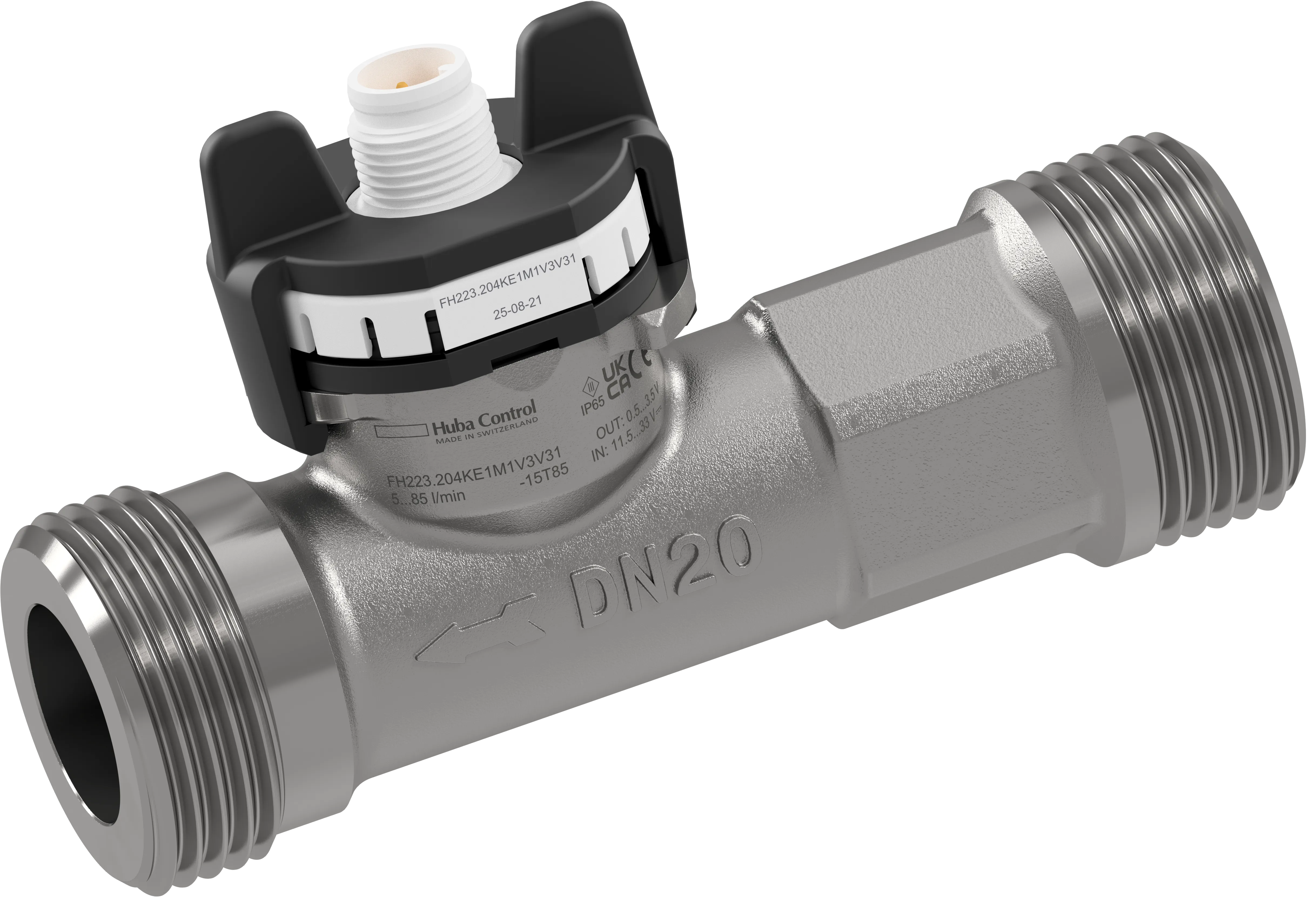
The next-generation FH2xx extends the capabilities of proven Vortex technology through a fully PFAS-free sensor design and a state-of-the-art electronics platform. Optimized response performance, flexible signal configurations, and multiple material options provide exceptional adaptability for HVAC, refrigeration, and industrial water systems.

Completely PFAS-free
The PFAS-free sensor platform is designed to reduce regulatory uncertainty and material-related risks, helping customers prepare for evolving environmental requirements. Its future-ready design safeguards investments and ensures long-term planning security for drinking water infrastructure.
Approvals and compliance
Designed with your application in mind, selected variants offer the relevant drinking water approvals and conformity certifications to support regulatory compliance and long-term reliability.

Optimized response threshold
Ensures reliable and highly accurate flow measurement, even at the lowest flow rates. The advanced design makes it ideally suited for modulating heat pumps and dynamic applications where wide turndown capability, rapid response, and low pressure loss are critical.

Zertifizierte Sicherheit
VDE Mark Approved gemäss EN IEC 60335-2-40. Für den sicheren Einsatz in Wärmepumpen mit Propan (R290) entwickelt. Anwendungsgrenzen und Medienverträglichkeit gemäss Datenblatt und Zertifikat.
A variety of output signals to suit your system requirements
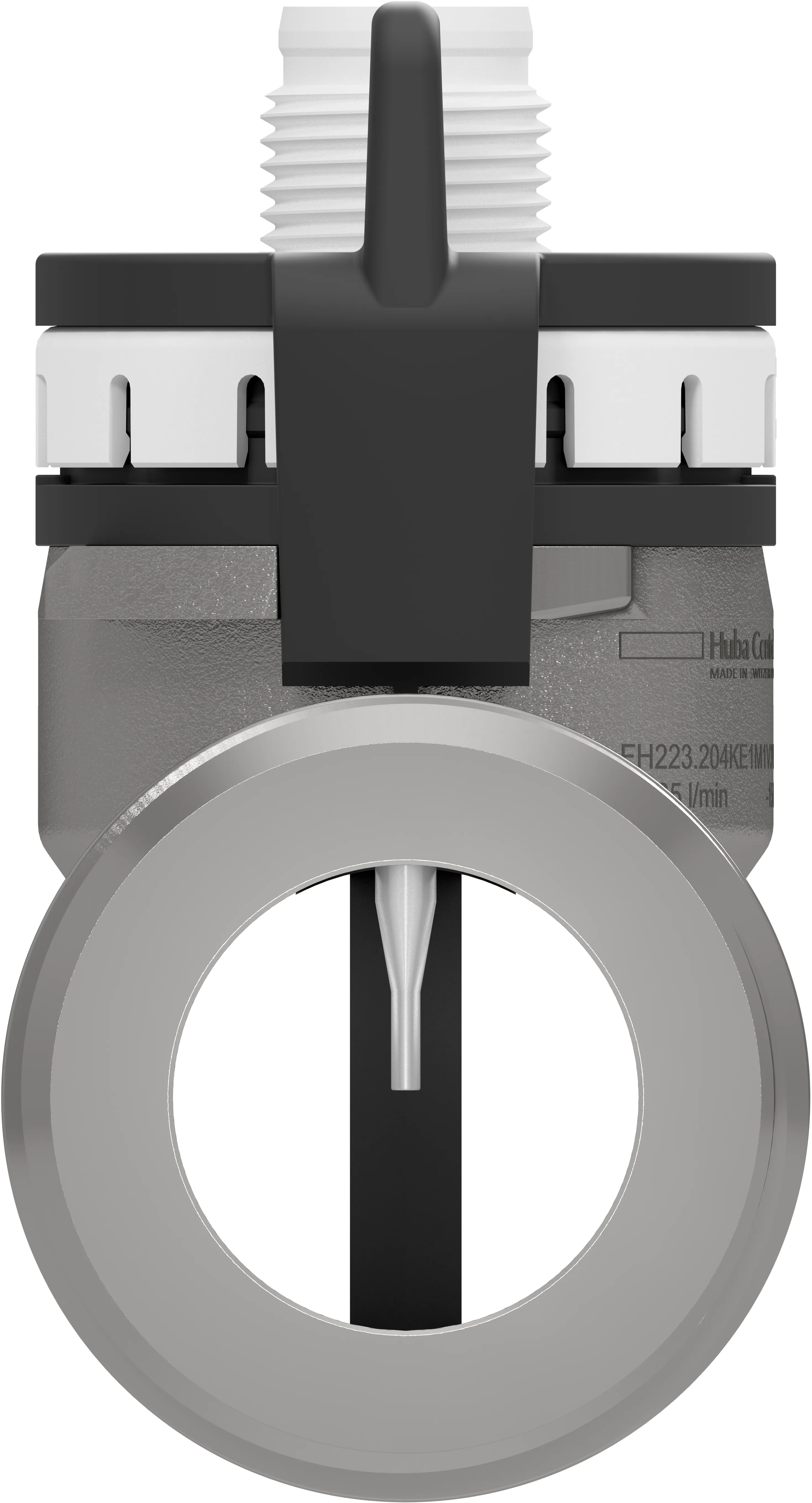
With selectable direct or filtered output signals, the new Vortex platform provides the flexibility to optimize signal behavior for a wide range of dynamic operating conditions.
Designed for high-speed response applications, the FH21x variants detect flow changes almost immediately and output the raw measurement signal without additional filtering.
Technical data
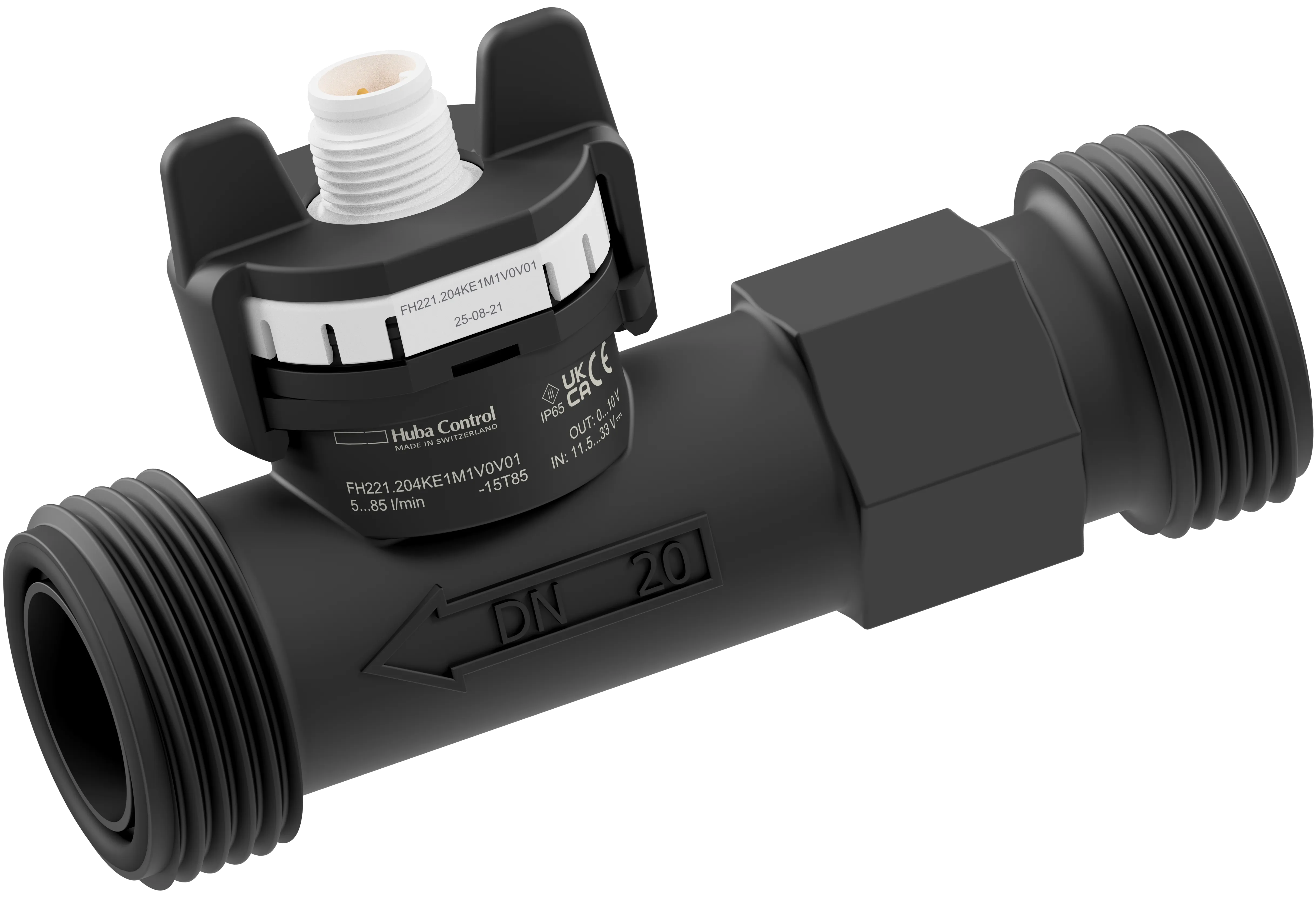
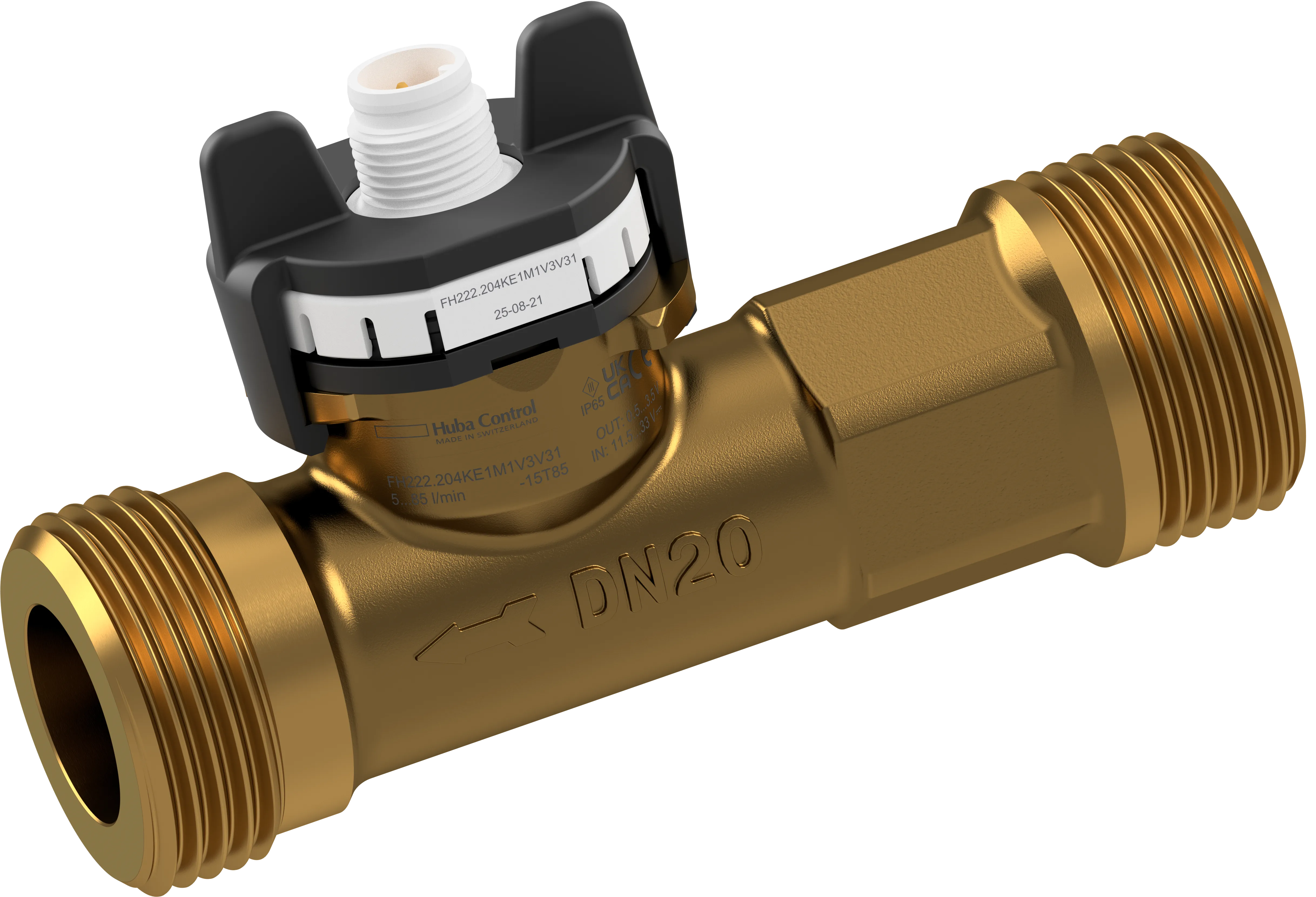
* preliminary values, as of 09/2026. Approvals and compliance depend on the version.
Frequently asked questions about vortex flow sensors
Measuring principle, water and sensing element
How does a vortex flow sensor work?
A vortex flow sensor detects the vortices that form behind a bluff body in a flowing liquid. The vortex shedding frequency is proportional to the flow velocity. The flow velocity can be converted into a volumetric flow rate and output accordingly.
Can Huba vortex flow sensors measure water?
Yes. All our vortex flow sensors are suitable for applications with water and water mixtures. These include different water qualities, drinking water, heating water with common additives and, specifically, water-glycol mixtures. FH2xx versions are suitable for the water qualities and additives approved for the respective version. Selection depends on water quality, additive concentration, temperature, materials and required approvals.
Which applications is the FH2xx platform designed for?
The FH2xx platform is designed for heating, ventilation and air conditioning systems and industrial water applications. These include modulating heat pumps where low flow rates also need to be measured during part-load operation. Suitable versions are available for heat pumps using propane R290. The approved media and operating limits of the specific version are decisive.
Does Huba Control use an encapsulated sensing element?
Yes. Our vortex flow sensors use encapsulated vortex detection in which the sensing element has no direct contact with the medium. This design is also used in FH2xx versions. The housing, sensor paddle and seals, however, are in contact with the medium. Their materials must therefore be compatible with the medium and operating conditions.
Why does vortex flow measurement work without moving parts?
Vortex flow measurement does not require a rotating impeller or a mechanical counter. Our sensors detect the vortices behind a stationary bluff body. This enables low-maintenance measurement without rotating components. The approved installation and operating conditions must be observed to obtain reliable measurements.
Does water need to be electrically conductive for vortex measurement?
No. Our vortex measuring principle is independent of the electrical conductivity of the medium. Nevertheless, the specific water quality must be compatible with the wetted materials and operating conditions. Independence from conductivity alone does not replace approval for a particular medium.
When is a vortex flow sensor not the right solution?
A vortex flow sensor is unsuitable when the application falls outside the approved measuring range or operating limits. Particularly at low volumetric flow rates, the lower measuring limit must match the actual minimum flow. Selection also takes viscosity, air content, contamination and installation conditions into account.
FH2xx platform and version selection
What distinguishes the new Huba FH2xx platform?
The FH2xx platform combines proven vortex technology with a completely PFAS-free sensor design and a new electronics platform. Scalable signal options, different housing materials and an optimised response threshold allow adaptation to different applications. FH21x provides a direct signal; FH22x provides a processed signal and an extended measuring range for low flow rates.
What is the difference between FH21x and FH22x?
FH21x outputs the unfiltered raw signal and is designed for high dynamic response. FH22x smooths the signal electronically and provides a lower response threshold at the same pressure loss. Typical response times are approximately 5 ms for FH21x and approximately 1 s for FH22x. These are typical values, not guaranteed maximum values. The appropriate signal characteristics depend on the control task.
When is the direct output signal of FH21x useful?
FH21x is suitable for applications that need to detect rapid flow changes and evaluate the signal immediately. Irregularities also remain visible in the direct signal. The controller must be compatible with the signal processing; filtering and plausibility checks must be considered when designing the system.
When is the processed output signal of FH22x useful?
FH22x is suitable for stable downstream processing and applications with low flow rates. Electronic smoothing reduces signal peaks. The typical response time of approximately 1 s must be considered when designing the system, particularly where rapid changes in flow are relevant.
Which housing materials does the FH2xx platform offer?
FH211 and FH221 use polyamide PA6T/6I with 40 % glass fibre. FH212 and FH222 have brass housings, while FH213 and FH223 use stainless steel 1.4301. The housing material alone does not determine compatibility with the medium. The sensor paddle and seals must also be compatible with the medium.
Which nominal sizes and flow ranges are specified for FH2xx?
Depending on the version, the FH2xx platform covers nominal sizes from DN 6 to DN 32. The flow ranges across the offered versions extend up to 150 or 240 l/min, respectively. These ranges cover several nominal sizes. The measuring range of the specific nominal size and ordering version is decisive for system design; the lowest and highest values in the family do not automatically apply to the same version.
When will the FH2xx sensors be available?
FH211, FH212, FH213, FH221, FH222 and FH223 are planned from Q1/2027. We will agree sample dates, series availability and delivery terms with you for the required version. Please send us your requirements and planned date of use.
Low flow and low flow rates
What does low flow mean for a vortex flow sensor?
Low flow refers to measuring low volumetric flow rates at the lower end of the intended measuring range. Our FH22x versions are designed for these applications. The lower measuring limit, the accuracy achievable at that limit and the conditions of the medium are decisive.
Which Huba vortex flow sensors are designed for low flow?
FH221, FH222 and FH223 are the low-flow versions of the FH2xx platform. They use electronic signal processing with a lower response threshold. The appropriate version depends on nominal size, actual flow range, medium, materials and required output signal.
Why is low flow relevant to modulating heat pumps?
In modulating heat pumps, volumetric flow can decrease during part-load operation. A low response threshold supports measurement of these low flow rates. FH22x enables reliable measurement within the intended part-load range. The benefit depends on the actual minimum flow, the medium and control dynamics. This alone does not establish a specific energy saving.
How are low flow and pressure loss related in FH22x?
Through electronic signal processing, FH22x achieves a lower response threshold at the same pressure loss compared with the corresponding FH21x version with the same nominal size and geometry. The sensor still causes a pressure loss. Hydraulic design must take account of the pressure loss values for the respective nominal size and intended operating point.
Temperature measurement and output signals
Are flow and one temperature measurement sufficient for heat measurement?
No. Determining transferred thermal power requires the temperature difference between supply and return, as well as appropriate fluid property data, in addition to volumetric flow. Integrated temperature measurement can provide part of this measurement chain. A single temperature value alone does not determine thermal power. Heat measurement for billing purposes must also comply with the applicable requirements.
Is a direct signal the same as a particular electrical output?
No. Direct or processed describes the signal conditioning. The electrical interface must be considered separately. A direct signal does not automatically specify a current or voltage output or a communication protocol. For integration, select both the appropriate signal conditioning and the appropriate electrical output.
Can the 2xx & FH200 platform be used at temperatures below the flow measurement operating range?
Yes. The integrated PT1000 or NTC10k temperature measurement detects temperatures down to −40 °C. Flow measurement is designed for reliable operation from −15 °C. Temperature information is therefore already available during very cold operating phases, allowing the controller to identify when conditions for reliable flow measurement have been reached. This is particularly suitable for refrigeration and heat pump applications using water-glycol mixtures.
Installation and reliable measurements
How do air bubbles and contamination affect measurement?
Air bubbles, an incompletely filled measuring tube or deposits can impair measurement. Vent the system and select the sensor to suit the expected water quality. The encapsulated sensing element protects vortex detection; wetted components and flow conditions remain decisive for reliable measurements.
Replacement and migration of existing sensors
Which Huba sensors can replace an existing OEM sensor?
We assess the appropriate Huba replacement version using the technical specifications of the existing sensor and the operating conditions of your system. The FH2xx family offers different material and signal options. A replacement recommendation requires mechanical, electrical and functional compatibility to be checked. Send us the existing type, data sheet and application requirements.
Is a Huba replacement sensor directly mechanically compatible?
A Huba replacement sensor is directly mechanically compatible only if the process connection, installation length, available space, sealing geometry, materials, flow direction and mounting requirements match. The same nominal size alone does not establish interchangeability. We support you in comparing dimensional drawings and assessing installation.
Are the supply, output signal and characteristic curve compatible when replacing a sensor?
Electrical compatibility depends on the supply, signal type, levels, load, characteristic curve, fault behaviour and temperature output. An output with the same name is insufficient if scaling or limits differ. The combination of replacement sensor and controller must be checked before making a change.
Can existing connectors, cables and pin assignments be reused?
Existing connectors and cables can be reused if the electrical pin assignment and mechanical connection match the new version. Also check the number of poles, coding, protection rating and temperature measurement connections. A connector that looks the same does not guarantee identical functionality.
Does the control software need to be adapted when changing sensors?
The control software must be adapted if the characteristic curve, filtering, update rate, temperature evaluation or fault behaviour of the new sensor differs. When switching between a direct and a processed signal, control dynamics must also be checked. The documented interface and a test with the actual controller are decisive.
Which checks are required before changing series production?
Mechanical, electrical and functional compatibility in the device must be demonstrated before changing series production. This includes minimum flow, temperature and pressure limits, start-up behaviour, disturbances, control and relevant approvals. We support you with a validation plan tailored to your application. Documented test results form the basis for your series production approval.
Approvals and technical enquiries
Which drinking water approvals are available for FH2xx?
Depending on the version, FH2xx is available with WRAS, ACS and UBA 1+ drinking water approvals. The approvals apply to the covered versions, materials, seals and operating conditions. We select the appropriately approved version for your drinking water application.
Is the FH2xx platform PFAS-free?
Yes. The FH2xx platform has a completely PFAS-free sensor design. The material declaration for the specific version describes the scope of delivery covered. The statement applies to the confirmed components and materials; accessories must be considered within the scope of the respective declaration. A PFAS-free design does not replace separate approval for a medium or application.
Which information does Huba need for data, samples and advice?
For data, samples and technical advice, we need the medium, additive concentration, minimum and maximum volumetric flow, nominal size, connection, temperature, pressure and required signals. Also provide temperature measurement requirements, necessary approvals and sample and series production dates. Use the contact form on this product page. Our regional advisers support you with selection, integration and validation.